



Nature is the teacher and we are the learners! In 35 years of Gaia Social, small saplings that were planted by children are, today, leafy trees. Since the 1990s, environmental education and local development have been our essence. This has led us to impact more than 200,000 people in the Amazon, Caatinga, Cerrado, and Atlantic Forest, with over a thousand initiatives and more than 100 projects in 23 states. In addition to managing and applying R$125 million of private and public social capital in the territories, with more than 75 companies and hundreds of partner institutes and organizations.
We understand that populations and communities in the territories do not need to be saved, but rather recognized as agents of development. They need space and support to pursue possible futures. It is from this point that we compiled our approach of local decolonial regenerative development.
We work with genuine dialogue and articulate civil society, the public sector, and the business community so that interventions bring real life improvements. In this process, our partners understand that our action goes beyond the technical view and encompasses different factors through an educator and learner role that ensures the success of our projects in a sustainable way.
In the beginning, back in the 1990s, we created an education methodology based on nature. At that time, we called it inter- and transdisciplinary, starting from the observation of nature and the city with children and teachers from schools in the interior of São Paulo. We worked on the need to care for our planet and our city to guarantee the continuity of life. After all, we already knew about the possibility of a future climate emergency scenario.
We also pioneered bringing environmental education to companies starting in 1994 and expanded our operations to other states. This happened in parallel with the creation of ISO 14000 (1996) and the drafting of the “Earth Charter,” initiated at ECO 92 and launched in 2000. The text of the charter advocates: “with the right to own, manage, and use natural resources comes the duty to prevent environmental damage and protect the rights of people.” Thus, we operated with the concept of the citizen company—which at the turn of the century evolved into corporate social responsibility.
Today, we act at the confluence of the interests of companies with communities and the public sector, which contributes to obtaining the “social license to operate.” For companies, beyond the environmental licensing inherent to large enterprises, this is an essential mechanism for operation. We function as a connection tool in this process so that the territories can benefit from the presence of these enterprises. A process that requires dialogue, transparency, a relationship of trust, and co-construction of planning and initiatives with the community, the public sector, and other local actors.
We understand that strengthening dialogue with communities and local actors, along with their capacities and autonomy, is fundamental within our approach. It is they who have always collectively resisted social or climatic events that affect local foundations. It is necessary to recognize and strengthen the protagonism of those who care for the place where they live. We act for the strengthening of territories, valuing history and traditional assets, nurturing the community’s regenerative innovative forces and potentials, to ensure they have solid foundations to overcome their challenges and build better futures.
Regeneration and Resilience in Practice
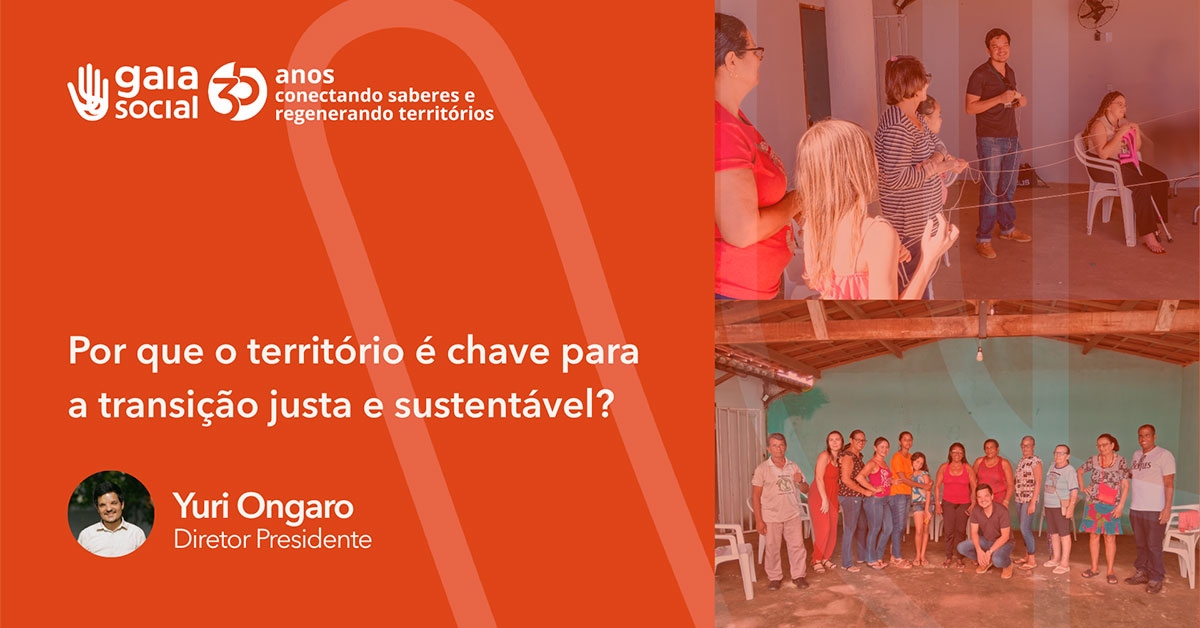
Our understanding of “decolonial doing” starts with construction with the community. When we arrive in a territory, we adopt a listening stance and seek to find where it is already regenerating itself. We look for ongoing initiatives, actions by cultural groups, associations of producers or entrepreneurs, and collectives of women and youth. Through dialogue with these actors, we understand how we can boost what is already happening locally.
We seek to systemically potentiate their relationships at the regional, national, and global levels, in the economic, environmental, cultural, and political dimensions. Often, what is missing is connecting, perfecting, and strengthening relationships with and between these dimensions, whether with public policies, programs, or cultural movements.
A good example is what we did in Serra da Canastra (Minas Gerais) during the pandemic, where we mapped and trained 38 leaders from 18 organizations to draft projects, fundraise, and manage them. In parallel, we acted systemically to implement legal frameworks, physical structures, equipment, population engagement, and strategic planning for CICANASTRA to improve waste management in the territory formed by seven municipalities.
Or the ReDES Program, in Bico do Papagaio (Tocantins), Northwest of Minas Gerais, and Vale do Ivinhema (Mato Grosso do Sul) in partnership with the Votorantim Institute and BNDES, where after a diagnosis of the territory, we developed 13 economic development and socio-productive inclusion projects. Nine years later, most of the initiatives are still alive, and there has been an increase in monthly gross income, the economically active population, and the possibility of access to work.
Building a Regenerative Future
Today, on the eve of COP 30, we are discussing mitigation goals, but we need to go further and move toward their real implementation, as the COP presidency calls on us to do. We also need to talk about climate adaptation—which for us needs to be regenerative, decolonial, and locally led.
Any design in this sense involves listening to communities about the climate challenges they are already facing or may face, such as desertification in the Caatinga or reduction of biodiversity, rainfall, and agricultural production. Or further, the risks of floods and the need for afforestation and cooling of urban spaces and peripheral neighborhoods that face major heatwaves.
The local decolonial regenerative approach is fundamental because through it, it is possible to understand what is being altered, who is suffering, what knowledge and solutions already exist, what capacities need to be strengthened, what knowledge and technologies can be complementary, and what works or does not work in the territory. Those who suffer directly also have the answers and the capacity to say what can be done to improve life.
Solutions arise from the communities, and success must be defined by them and with them. This is a thought aligned with the eight LLA (Locally Led Adaptation) principles, defined by the Global Commission on Adaptation in 2021 so that local communities have leadership in adapting to climate change in their own territory.
Our role is to facilitate, connect, and articulate interests in collaborative work with populations, traditional communities, companies, civil society, academia, and the public sector. We create strategic plans for local development, impact mitigation projects with regenerative networks and chains, and strengthen the relationship with nature by delivering concrete solutions for education for sustainability.
We trust in a decolonial regeneration of the “now,” connecting knowledge and regenerating territories. And we do not do it alone, which is why we invite you to connect with us and be part of this active transformation and of our next 35 years.