



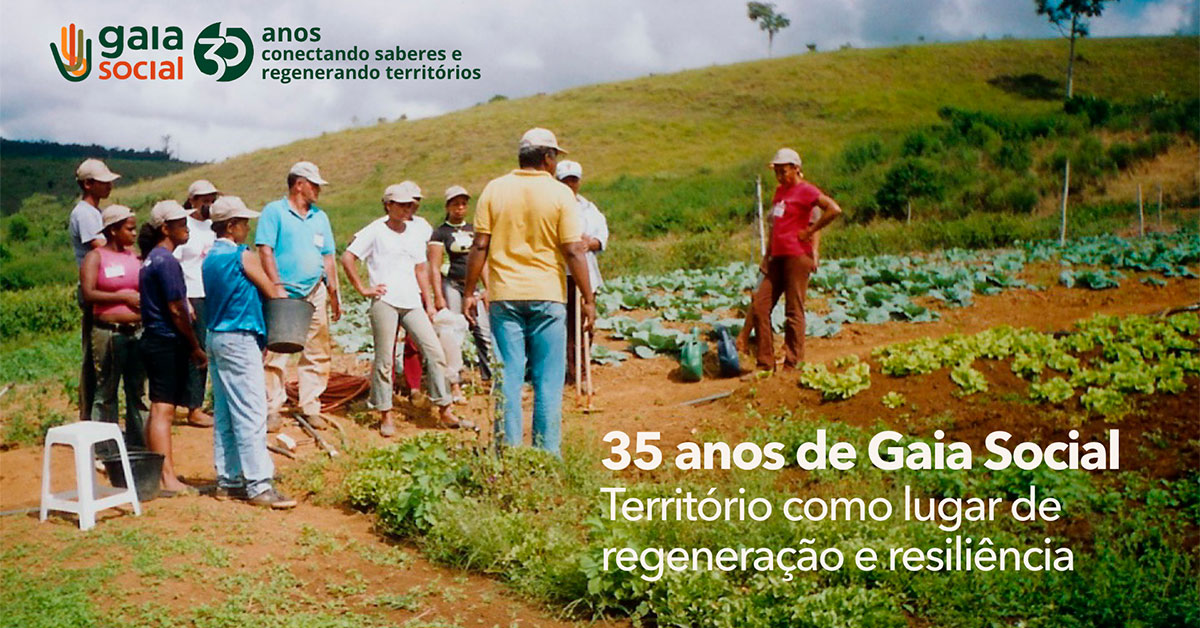
For 35 years, Gaia Social has worked for a possible future, built in a regenerative and decolonial manner. And as Ailton Krenak reminds us, this future is ancestral. Therefore, we look to our roots and the traditional knowledge of the territories, because that is where many of the answers and questions we seek come from. Communities are our guide to achieving living well (bem-viver), in harmony with nature, and to recognizing ourselves as part of it.
A just and sustainable transition—which encompasses a series of transformations for the preservation of the planet and the guarantee of life and socioeconomic justice—appears increasingly in the speeches of governments, the private sector, and civil society. But this transition will only exist if it is led by communities with guarantees of climate justice. It must be based on local knowledge that the bioeconomy will include, mitigate, and adapt. It is in the peripheries of large centers that movements for access to fundamental rights are born. No transition will be sustainable if it is not just, and it will not be just without those who sow and nurture harmonious coexistence among all forms of life, especially by having their vulnerabilities to the climate crisis eliminated.
Three months ago, the 10th edition of the “Sustainable Development Report” (#SDR2025) was released by the UN’s @Sustainable Development Solutions Network (SDSN). In Brazil, we saw setbacks in the last year regarding Sustainable Development Goals (SDGs) 2 and 10: Zero Hunger and Sustainable Agriculture, and Reduced Inequalities, respectively. This reveals that a transition transforming the structures that sustain inequalities is urgent, as is promoting the production of accessible, healthy, and safe food, starting from the communities.
It is the territories that bring the original meaning of the word “economy”: caring for the home. But a broad home, of relationships and lives, for we inhabit and are the very environment that surrounds us. The transition must be toward renewable, clean, and accessible energies, but in Brazil’s case, prioritizing the bioeconomy, with resources remaining in the community ; toward progressive taxation, which falls more on income and assets than on consumption, and charges proportionally more from those who have more ; toward the regeneration of biomes and communities, guaranteeing the survival of this home of ours and of those who live in and care for it ; and toward the agroecological transition, which generates work and income with safe food production for all. There is no environmental transition without this series of social and economic transitions.
Decoloniality as a method
Gaia Social seeks to act with a decolonial perspective—breaking with a heritage of cultural and economic domination. We work to understand communities based on themselves, and not through a pre-existing, foreign lens. We seek to promote regeneration, thinking and acting beyond sustainability. To this end, when we arrive in territories, we are preferably listeners. We dedicate ourselves to comprehending the local dynamics, their cultures, their environmental, social, and economic assets, and understanding what has worked and what has not in similar initiatives. The exchange with communities is where we start, to be a resource and sow paths together with them.
Since I had the happiness of assuming the management of Gaia Social in 2022, I made a point of not distancing myself from the territories. Our strategy is designed starting from the communities, and the learner stance is an essential value of Gaia Social. Equally happily, I found this same stance working with Lucilene Danciguer, my partner in this journey.
Decoloniality and regeneration are premises of our work, acting for a just transition. This transition may be lengthy, and it needs to take root. Each territory has its dynamics and particularities. We act by being a resource, strengthening, expanding, and highlighting the potentials of each location where we are invited.
The future is ancestral
Although we have had advances, there is much to be done for a just and sustainable transition. The community living of traditional populations can inspire us on vital themes such as economy, violence, food, health, education, and even adaptation technologies for increasingly dense urban zones.
Examples include short food cycles, which guarantee accessibility and safety in community gardens and urban orchards. Emancipatory education, contextualized and “unwalled” (desemparedada), creating learning environments everywhere. The cultivation of biodiversity in the urban environment, with nature-based solutions and disaster risk reduction. Community living that is democratic, valuing diversity, and promoting collective health.
In Irecê, in the Bahian Sertão (hinterlands), we work in partnership with the Instituto Lina Galvani, the Anísio Teixeira School, and Raízes do Sertão. After a careful process of listening and validating ideas, we initiated the articulation to enhance the school’s productive agroecological backyard, which is located in a Quilombola community and promotes antiracist education. In this sacred space, we have been a resource for the school, for the Secretariat of Agriculture, and for the Raízes do Sertão nucleus, which has trained family farmers in participatory organic certification, encouraging practices for agroecological transition and adaptation in a territory at risk of desertification.
Schools are vital places to foster this transition. Children are everything they need to be, but they have constantly suffered from the already present climate crisis and secular ills of the socioeconomic crisis we live in Brazil. For many children, the right to enjoy life as children was and is usurped. Since 1990, Gaia Social has worked with schools, from the early days of Environmental Education to the recent needs to transform these spaces into climate shelters. In the children’s hope (esperançar), we must also find inspiration and liveliness to fulfill this transition. The existence of an abyss of conditions for healthy child development, depending on where one comes from, is unacceptable.
It is our commitment at Gaia Social to act for the territories, with the territories. We are immensely grateful, in these 35 years, for the support of investing and executing partners in the projects we have fostered where we operate, but mainly we thank the communities that welcome us and share their knowledge, practices, and ways of living with us.
We need to regenerate relationships and transform the structures that sustain our inequalities. This is not a partisan issue, but an agenda for necessary futures; this is the just transition in fact. We have a strategic opportunity this year with COP30 and eyes turned toward the paths proposed by Brazil for climate, social, and economic justice. And it is from the Quilombola and Indigenous communities, the peripheries, and other territories that we will listen to the paths we must tread.